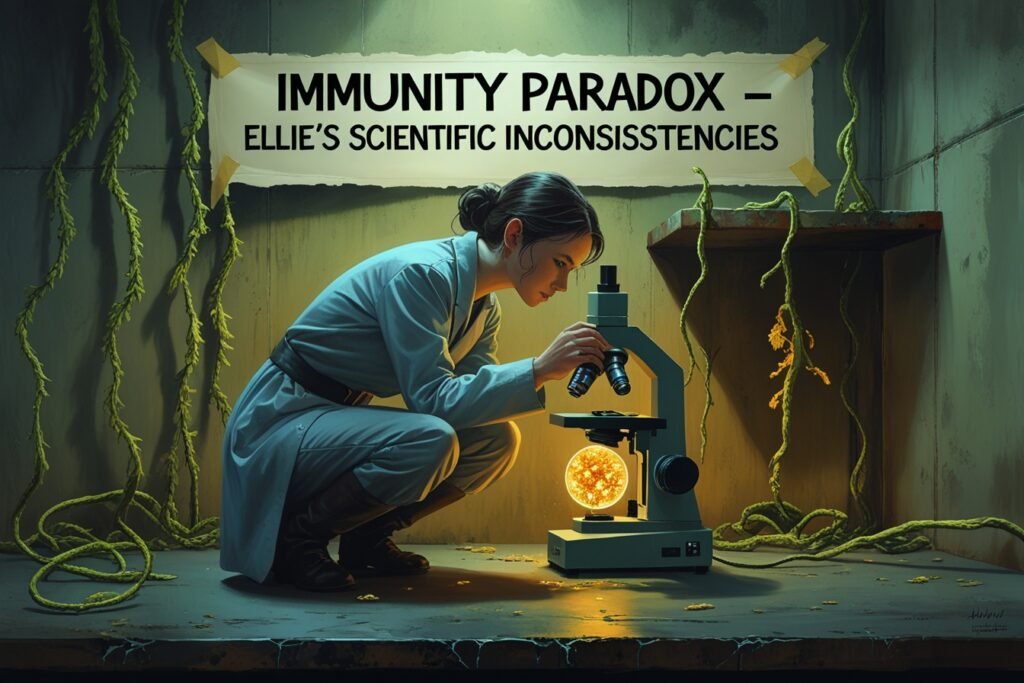

What if one of the greatest mysteries in The Last of Us Part 2 isn’t just about survival in a ravaged world but about an inexplicable biological twist that defies science itself? Enter the Immunity Paradox, where Ellie’s resistance to the dreaded Cordyceps infection becomes the fulcrum of a narrative that mingles heart-wrenching drama with puzzling scientific anomalies. This article unpacks the layers of Ellie’s Immunity, scrutinizing the contradictions and controversies that make her one of gaming’s most debated characters. Get ready to dive into a world where fiction’s bold storytelling meets biological improbabilities, creating a paradox that both fascinates and perplexes players and critics alike.
The Mystery of Ellie’s Resistance:
At the heart of The Last of Us Part 2, Ellie stands as a beacon of hope and an enigma in the realm of bio-intricacies. Despite living in a post-apocalyptic world overrun by the pathogen that turns people into monstrous hosts, Ellie remains inexplicably immune to the Cordyceps virus. Her resistance, often hailed as a miraculous stroke of fate, is shrouded in scientific ambiguity.
While the game hints at an inherited anomaly or some rare genetic mutation, the details are deliberately vague, leaving fans yearning for a deeper explanation. This deliberate mystery fuels theories and debates, as players try to reconcile her immunity with known principles of microbiology and immunology. The beauty of Ellie’s character lies in this very contradiction, a symbol of hope wrapped in the inexplicable unpredictability of nature.
How Does Ellie Defy the Cordyceps Curse?
The Immunity Paradox forces us to examine Ellie’s body not as a typical host of a fungal infection but as a unique laboratory of resistance. In real-world terms, the Cordyceps fungus aggressively invades and takes over its host, yet Ellie’s system somehow denies this fatal process. Some theorists suggest that her body might produce special chemical messengers that misdirect the infection, akin to a biological ruse that tricks the invasive fungus into standing down.
However, such explanations stray far from established science. In the context of The Last of Us Part 2, her immunity might represent a form of hyper-evolved defense, a supercharged reaction that stops the fungus in its tracks. While this idea challenges our understanding of scientific logic, it perfectly serves the game’s narrative purpose, creating an eerie yet captivating canvas for storytelling.
The Science Behind a Fictional Phenomenon:
Despite numerous attempts by both fans and academic-minded critics to rationalize Ellie’s immunity, significant scientific inconsistencies remain. In conventional immunology, even a minor resistance to a pathogen typically involves measurable, yet imperfect, defense mechanisms. Ellie’s complete and seemingly unassailable resistance raises many skeptical eyebrows.
Critics argue that if her immune system had evolved to counter the Cordyceps fungus, there would be detectable anomalies in her blood chemistry or brain structure, details that the game glosses over. Instead, her immunity is often presented as a one-off marvel rather than a consequence of any identifiable biological process. This blend of hyperbolic storytelling and selective scientific detail creates a tension, a paradox, that keeps players questioning the limits of realistic science in video games.
Narrative and Science in Collision:
The strength of The Last of Us Part 2 lies in its richly woven narrative, but when storytelling meets hard science, the results can be both brilliant and baffling. The game’s creators intentionally leave many questions about Ellie’s immunity unanswered, prioritizing emotional impact over scientific rigor. This decision has led to what many call a “cyber fungal paradox,” where a beloved narrative element clashes with the expectations of scientific accuracy.
By embedding these inconsistencies, the game not only sparks intellectual debate but also mirrors the chaotic nature of its post-apocalyptic setting. Here, contradictions are part of the lived reality, much like the unpredictable spread of a fungus in a devastated ecosystem. While some purists may balk at the scientific liberties taken, many argue that this deliberate fuzziness adds a layer of realism to a world where nothing is quite as it seems.
Balancing Storytelling and Scientific Plausibility:
Balancing deep narrative themes with technical scientific plausibility is a monumental task, and The Last of Us Part 2 walks a tightrope between emotional storytelling and the logic of biology. On one side, Ellie’s immunity serves as a narrative device that propels the story forward and deepens player engagement. On the other hand, it raises uncomfortable questions about consistency within a world defined by biological apocalypse.
This critical analysis reveals a broader truth about storytelling in video games: sometimes, dramatic necessity trumps scientific credibility. The Immunity Paradox is less about providing a detailed explanation for Ellie’s unique condition and more about using that mystery to explore themes of hope, survival, and the unpredictable nature of life. In embracing these inconsistencies, the game invites players to accept that not every question has, or needs, a clear answer.
Ongoing Debates Among Fans and Critics:
Since its release, The Last of Us Part 2 has ignited numerous debates about the logic behind Ellie’s immunity. Fans scour every piece of dialogue, medical jargon, and in-game detail for clues, often leading to passionate discussions on online forums and social media platforms. Critics, too, are divided; some laud the game for its creative boldness, while others accuse it of neglecting scientific responsibility.
This ongoing discourse is emblematic of the Immunity Paradox itself, a symbol of the tension between narrative ambition and scientific skepticism. Whether Ellie’s immunity is a miraculous anomaly or a convenient plot contrivance remains one of the game’s most enduring mysteries. What is clear, however, is that this very ambiguity continues to spark engaging conversations that keep The Last of Us Part 2 in the spotlight long after the credits roll.
Conclusion:
Ellie’s Immunity Paradox encapsulates the delicate interplay between storytelling and science in The Last of Us Part 2. While her resistance to the Cordyceps infection remains shrouded in scientific inconsistencies, it is precisely these contradictions that drive the narrative forward and engage fans in endless debate.
FAQs:
1. What is the Immunity Paradox in The Last of Us Part 2?
It refers to the mysterious and unexplained nature of Ellie’s resistance to the Cordyceps infection, which defies conventional scientific explanation.
2. How does Ellie’s immunity challenge normal biological principles?
Unlike typical hosts, Ellie shows no signs of the aggressive fungal takeover seen in others, suggesting an unexplained genetic or biochemical anomaly.
3. Why do some critics view Ellie’s immunity as a weakness in the narrative?
Critics argue that her immunity lacks scientific plausibility and creates inconsistencies when compared to real-world immunology.
4. What role does Ellie’s immunity play in the game’s story?
Her immunity is a central plot element that drives the narrative, fuels emotional tension, and raises existential questions about hope and survival.
5. Are there any scientific explanations provided for Ellie’s unique condition?
The game hints at genetic mutations or special chemical messengers, but it intentionally leaves many details vague to prioritize storytelling.
6. How has Ellie’s immunity influenced fan discussions around The Last of Us Part 2?
It has sparked extensive debates and theories online, leading to passionate discussions about the balance between narrative creativity and scientific accuracy.

Leave a Reply