
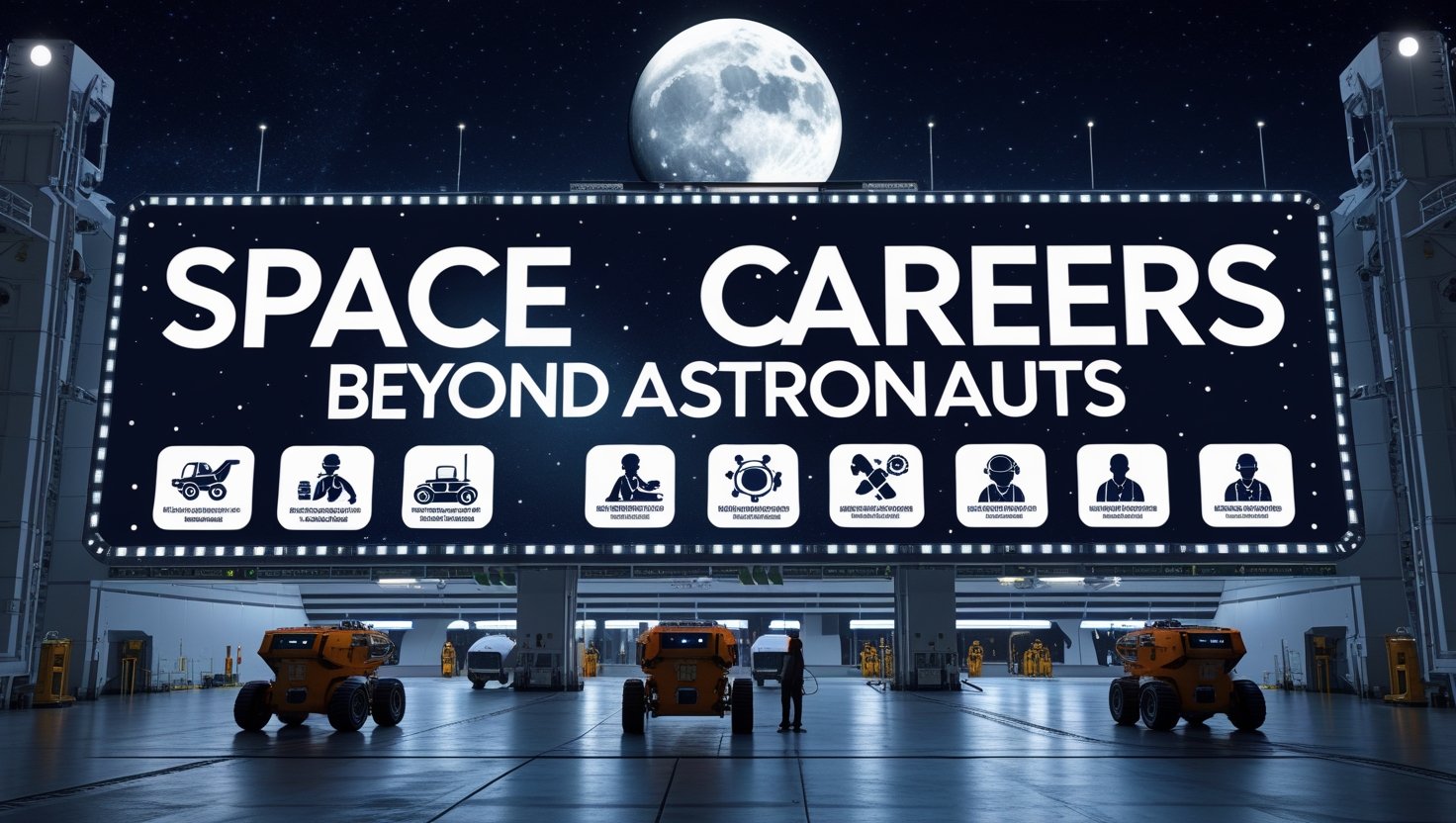
What if your day job involved decoding planetary ruins or growing lettuce under Martian skies? The space industry is no longer just about rockets and astronauts. Today’s cosmic frontier demands a vast array of specialists, from data wizards to policy architects, each playing a critical role in humanity’s push beyond Earth’s cradle. Whether you dream of designing lunar habitats or crafting the laws that govern orbital traffic, there’s a space career waiting for talents like yours.
Space Archaeologist & Planetary Surveyor:
Peering through satellite imagery and rover photos, space archaeologists transform ancient history into cosmic insight. They map out lost Martian riverbeds or pinpoint vestiges of water-carved canyons, revealing how planets evolved. On Earth, they repurpose LiDAR and spectral analysis tools, once used for terrestrial ruins, to survey meteorite impact sites.
Partnered with planetary surveyors, who chart topography and soil composition, these experts lay the groundwork for future settlements by identifying stable ground and potential water sources. If you love detective work and have a flair for remote sensing technology, carving out our celestial past could be your calling.
Space Architect & Habitat Engineer:
Imagine drafting floor plans for a lunar greenhouse or calculating radiation shielding for a Martian dome. Space architects blend traditional architectural principles with life-support engineering, crafting habitats that withstand micrometeorites, cosmic radiation, and extreme temperature swings. Using virtual reality and advanced materials science, they prototype modules that fold, self-repair, or even 3D-print themselves from local regolith.
Working alongside habitat engineers, they integrate air-filtration, hydroponic gardens, and AI-driven life-support systems. For creative problem solvers with a passion for space exploration, this role lets you build homes among the stars, literally.
Space Food Scientist & Nutritional Innovator:
Long-duration missions hinge on more than freeze-dried chili, it’s about mental health, muscle maintenance, and microbial balance. Space food scientists engineer diets that pack calories, nutrients, and flavor while minimizing waste and mass. They spearhead projects like onboard vegetable farms, algae-based protein bars, and edible packaging to stretch shelf life from three to five years.
By personalizing menus based on astronaut genetics and gut microbiomes, they guard against bone loss and immune decline. If you’re fascinated by biochemistry, agriculture, and culinary arts, this is a uniquely delicious space career.
Space Debris Analyst & Traffic Manager:
Every defunct satellite and spent rocket stage zipping around Earth poses collision risks. Space debris analysts monitor thousands of objects via radar and optical tracking networks, predicting potential conjunctions down to meters. When a hazardous pass looms, space traffic managers coordinate course-change maneuvers for active spacecraft, ensuring critical science missions avoid Kessler-syndrome cascades.
They draft emergency protocols, consult with international agencies, and design debris-removal concepts, like harpoon nets or magnet-equipped satellites. If you thrive on real-time problem solving and global collaboration, protecting our orbital neighborhood offers a front-row seat to cosmic stewardship.
Space Lawyer & Policy Advocate:
As private companies race to mine asteroids and sell lunar land rights, clear legal frameworks are essential. Space lawyers specialize in treaty law, export controls, and liability issues, drafting contracts that span multiple jurisdictions, advising on intellectual property for space technologies, and negotiating resource-sharing agreements. Meanwhile, policy advocates liaise with governments and NGOs to shape national space strategies, ensure peaceful uses of orbital slots, and integrate sustainability guidelines into new regulations.
If you love debate, international relations, and a dash of futurism, drafting the rules for humanity’s off-world ventures is your ticket to the stars.
Orbital Data Scientist & Earth Observation Specialist:
With thousands of active satellites feeding petabytes of Earth-observation data, raw numbers aren’t enough. Orbital data scientists apply machine learning to spot deforestation hot spots, track shifting sea ice, or forecast natural disasters in real time. They fuse multispectral imagery, radar scans, and IoT sensor feeds to generate actionable insights, helping everything from climate research to precision agriculture.
By translating terabytes into trend lines and heat maps, they empower governments, NGOs, and corporations to make informed, planet-wide decisions. If you’re a coding whiz with an eye for patterns, harnessing space-derived data could be your launchpad.
Space Software & AI Engineer:
From flight-control algorithms on lunar landers to autonomous navigation in Mars rovers, robust software is mission-critical. Space software engineers develop fault-tolerant code for embedded systems, real-time communications, and simulation platforms. They work hand in glove with AI specialists to build onboard decision-making, enabling spacecraft to dodge hazards or optimize resource usage without ground input.
This role demands mastery of C/C++, Python, and ROS (Robot Operating System), plus rigorous testing under simulated radiation and temperature extremes. If debugging under pressure excites you, writing the code that powers cosmic explorers is an out-of-this-world opportunity.
Conclusion:
The breadth of space careers now stretches far beyond the astronaut corps. Whether you’re driven by history, hospitality, law, or code, there’s a niche in today’s space industry that needs your expertise. As commercial ventures accelerate and interplanetary ambitions grow, these roles will only expand, inviting you to stake your claim in humanity’s next great odyssey. Which path will you chart among the stars?
FAQs:
1. Do I need a STEM degree for space careers?
Most roles favor STEM credentials, but fields like law or policy accept varied academic backgrounds.
2. What skills do space architects require?
They need architecture or engineering degrees plus expertise in materials science and life-support systems.
3. How do I become a space food scientist?
Pursue food science, biochemistry, or nutrition, then specialize in zero-gravity and shelf-stability research.
4. Is programming vital for space data science?
Yes—proficiency in Python, R, or MATLAB and machine-learning frameworks is essential.
5. What’s the job outlook in space debris management?
Growing fast. With more satellites launching, demand for collision-avoidance and debris-removal experts is surging.
6. Can non-engineers enter the space industry?
Absolutely. Communications, legal, policy, and business roles welcome diverse skills to support expanding ventures.

Leave a Reply