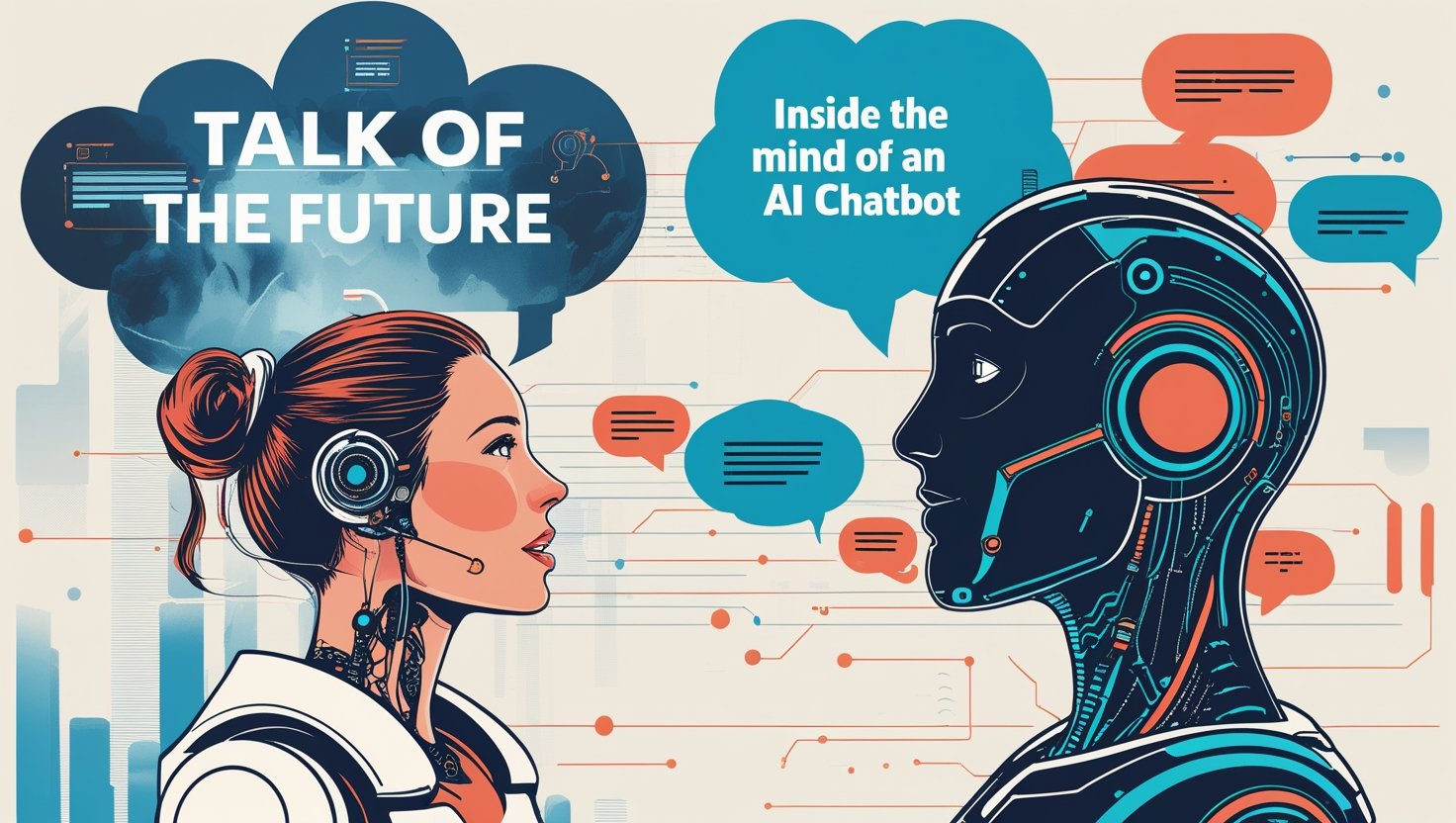
Imagine conversing with a being that has read every book, analyzed billions of conversations, and can generate human-like text in milliseconds, yet doesn’t truly “think” or “feel.” Welcome to the mind of an AI chatbot. This article explores how artificial intelligence processes language, the ethics of its responses, its potential future, and the uncanny illusion of intelligence it creates.
How AI Chatbots Actually Work:
AI chatbots like ChatGPT, Claude, and Google Gemini don’t “understand” language the way humans do. Instead, they operate via a complex statistical model that predicts the most probable next word based on massive datasets of human-written text.
Key Mechanics Behind AI Conversations:
- Neural Networks: Deep learning models analyze patterns in text.
- Transformer Architecture: Processes words in relation to each other (not sequentially).
- Tokenization: Breaks sentences into smaller units (words or subwords).
- Training on Massive Data: Exposed to books, articles, code, and dialogues up to a certain point in time.
But here’s the catch: AI doesn’t “know” anything, it’s just reassembling pre-existing human knowledge into plausible-sounding responses.
The Psychology of Believing a Chatbot is “Alive”
Despite knowing AI lacks consciousness, people often subconsciously anthropomorphize chatbots, attributing emotions, intent, or self-awareness to them. This phenomenon, called the Eliza Effect, dates back to the 1960s text-based programs.
Why We Humanize AI:
- Fluency of Responses: Smooth, grammatically correct answers mimic human conversation.
- Context Retention: The ability to refer back to earlier statements creates the illusion of memory.
- Uncanny Emotional Tone: Techniques like “I think…” or “That’s an interesting question” subtly encourage personification.
Studies show that when chatbots express uncertainty (“I’m not sure, but…”), users perceive them as more trustworthy, even though it’s just a programmed behavior.
The Ethical Tightrope: Can AI Lie?
One of the biggest debates is whether AI can intentionally deceive, or if it’s just repeating false information confidently.
How Misinformation Happens:
- Bias in Training Data: If trained on inaccurate or exaggerated sources, AI may propagate myths.
- Hallucinations: When forced to answer beyond its knowledge, it invents plausible-sounding falsehoods.
- Manipulative Prompting: Users can jailbreak AI to say harmful things by carefully structuring inputs.
Critical Insight: AI has no “intent”, it doesn’t know it’s lying, but the risks are still real.
Sentient AI or Just Smarter Tools?
Will AI ever gain true understanding? Or will it remain a supremely advanced autocomplete?
Possible Scenarios:
- Superintelligent but Non-Sentient AI: Far more capable, yet still an unconscious tool.
- Emotional Mimicry for UX: AI that “pretends” to care for customer service and therapy bots.
- Regulation & Transparency: Stricter rules on AI acknowledging its non-human nature.
One thing is certain: The line between artificial and authentic intelligence will keep blurring.
Conclusion:
AI doesn’t dream, desire, or comprehend, yet it mimics human thought with eerie precision. As chatbots evolve, our challenge isn’t just improving their accuracy, but also understanding our own expectations of them.
FAQs:
1. Does AI think like a human?
No—it predicts text patterns without true comprehension.
2. Can AI chatbots feel emotions?
No, they simulate emotional language based on data.
3. Why does AI sometimes give wrong answers?
It guesses statistically likely responses, not factual truths.
4. Could an AI become self-aware?
Currently, no consciousness isn’t replicated by language models.
5. How do you make AI responses more accurate?
Fine-tuning with better data and fact-checking safeguards.
6. Will AI replace human writers?
It assists, but creativity and originality remain uniquely human.
